The Egg: a printed ball hull
A round, self-righting Buoy-Bot that prints on a 250 mm desktop printer. Both thrusters ride inside shrouded tunnels with nothing sticking out, a lead dish keeps it upright, and the top comes off by hand with a screw-on ring.
It is the alternative to the spar, with the same electronics, firmware and app inside a different hull.
Designed, checked, first part printed. Every part has been modelled, sliced and checked layer by layer for printing, and the hull's stability has been worked out from the model. The dome has been printed from its slicer project, in PLA with no supports. Nothing else has been printed and nothing has been floated, so every other figure on this page comes from the 3D model, the slicer or the hydrostatics. The first buoy is a test article, to be measured against the spar.
What shapes it
| Fits the course | The size of a waterski turn buoy: 236 mm wide and 151 mm out of the water, inside the regulation window of 20–28 cm wide and 8–17 cm up |
| Nothing to catch a ski | No mast, no struts, nothing protruding. The thrusters are inside the hull, behind grilles |
| Self-righting | Rights itself from any angle of heel; metacentric height at least 40 mm |
| Prints at home | Every part fits a 250 mm cube and prints without support. The threads that hold it together are part of the print |
| Watertight from a printer | Walls printed solid, a coat of epoxy outside, a radial O-ring seal at the only joint, and a pressure test before anything goes inside |
| Opens by hand | No tools to get inside, and a thruster swaps with one nut and no splicing |
| The dome never turns | So no wire inside winds up, and the compass comes back at the same heading every time it is closed |
Why a ball
A ball is the shape a skier expects at a turn, and the smallest hull that can carry the batteries, electronics and two thrusters without anything outside it. Its weight sits low — the lead under the floor, the battery just above the tunnels — so it stands back up from any angle, and the dome on top holds the antenna as high as a 236 mm ball allows.
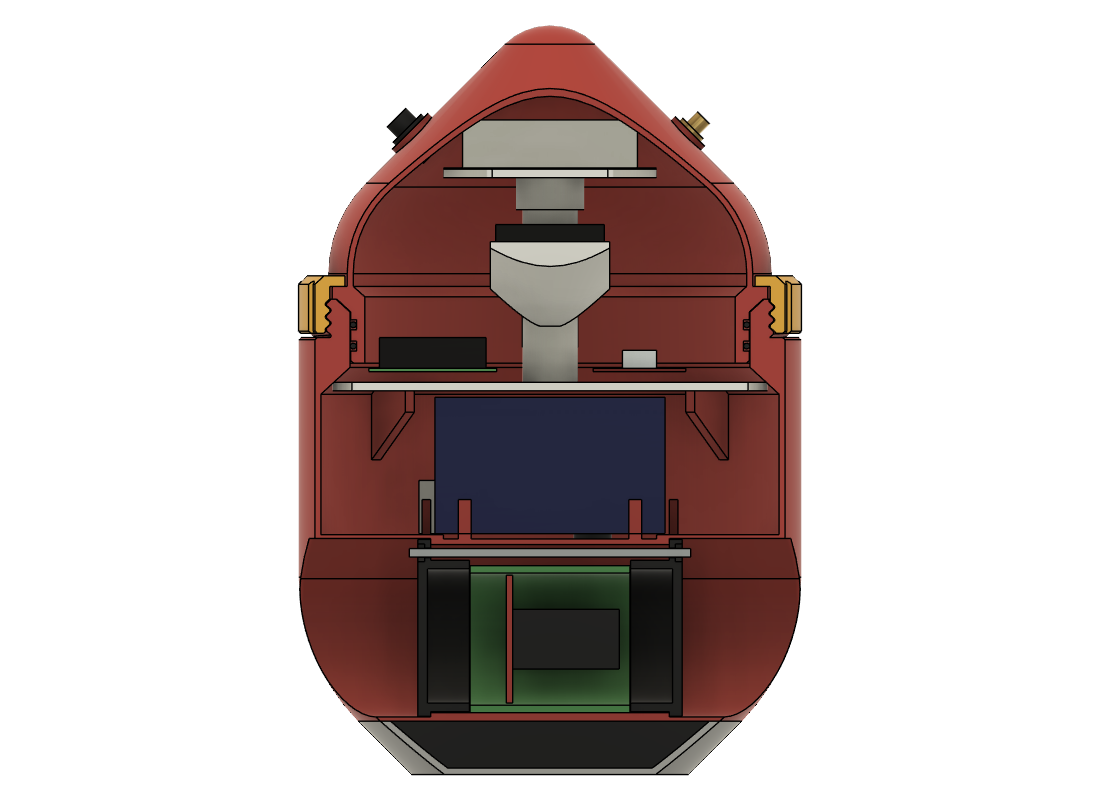
- GNSS antenna On a 100 mm aluminium ground plane, on a platform that slips over the mast top, in the dome's tip: about 107 mm above the water.
- Feather The controller and radio, on the port shelf, about 50 mm above the water.
- Compass Flat on the starboard shelf, chip side up. About 170 mm from the motor magnets, which is the design's biggest open question.
- Ring and thread A printed two-start thread with 45° flanks. The ring closes in 1⅓ turns by hand and holds the dome down; the dome itself never turns.
- Two O-rings On the dome's spigot, sealing sideways in the hull's bore. They need only the push of fitting the dome, not a tight ring.
- Still waterline The dashed rule. It sits 5 mm below the shoulder the ring rests on, so the joint only sees splashes.
- Deck A plate on four ribs, screwed down, carrying the carrier board and the GPS board, and the mast for the shelves and the antenna. It lifts out in one piece.
- Battery One stock 6 Ah LiFePO4 pack on bulkheads above the tunnels, between posts. The deck above keeps it in place if the buoy is ever upside down.
- Cable gland Each thruster's leads come up out of its tunnel through a sealed gland into the dry hull, where the connectors are.
- Grille plug and tie rod A plug closes each tunnel end, clamps the pod through a sleeve and keeps skis, ropes and fingers out. One stainless rod per tunnel pulls the pair together.
- Thruster pod In its own fore-and-aft tunnel, its axis 135 mm under the surface. The hull is its shroud.
- Keyway Takes the pod's mounting lug so it cannot turn. Its roof rises at 45°, so it prints without support.
- Lead dish About 2.3 kg of lead set in epoxy, screwed under the hull. A rope eye underneath takes a retrieval line.
A section through the middle, looking aft from the bow, so port is on the right. The dome, ring, deck and tunnels are cut; the grille plugs are seen beyond the cut.
Thrusters in tunnels
Each pod slides into its own tunnel low in the hull. Sleeves on the grille plugs clamp it from both ends, so thrust goes through the plugs into a step in the bore and the tie rod never carries it.
A ring, not a screw-on dome
A hand-tight ring cannot squeeze a 200 mm face seal, so the O-rings seal sideways instead and the ring only holds the dome down. A key at the bow puts the dome back the same way round every time.
Weight low, thrust low
Lead under the floor and the battery just above the tunnels make it stand back up from any angle. The tunnels sit 41 mm below the drag centre, so thrust heels it slightly: 1.5° at normal station-keeping thrust.
Smooth, but hard. Nothing on the ball can catch a ski, and the ring around its middle acts as a bumper. But the shell is printed PLA and the whole buoy weighs 6 kg, where a regulation turn ball is a few hundred grams of soft PVC. A soft skin — bonded foam, or a cover printed in flexible filament — is the obvious next step, and nobody skis at it before a strike test.
The numbers
| Hull | 236 mm across, 351 mm tall, printed in PLA |
| Draft | 200 mm, with 151 mm out of the water; it works in about half a metre of water |
| All-up mass | 6.0 kg |
| Ballast | 2.30 kg of lead nominal; the dish holds 2.52 kg |
| Metacentric height | 54 mm (requirement: 40 mm). It rights itself from any angle, most strongly at 110° of heel |
| Heel under thrust | 1.5° at normal station-keeping thrust; 7.3° at the most one battery can supply |
| Heel in an 18 mph wind | about 2° |
| Thrusters | Two stock pods in 72 mm tunnels, axes 84 mm apart and 135 mm under the surface |
| Draft sensitivity | about 23 mm per kg |
| Endurance | about 2.3 h on one 6 Ah pack, at the duty that gives the spar 4.7 h on two |
| Opening | 205 mm, once the ring is off and the dome lifted |
| Printing | 10 parts, 1.9 kg of PLA, about 52 hours; the hull alone 26½ hours |
Three modules, no tools
| Module | What it is | Serviced |
|---|---|---|
| Hull | The printed shell with both tunnels and their grille plugs, the pods, the glands, the bulkheads that carry the battery, and the lead dish underneath | Stays put |
| Deck | A plate carrying the carrier board and the GPS board, with a mast for the compass shelf, the Feather shelf and the antenna platform | Lifts out, then the battery |
| Dome & ring | The top with its O-rings, the charge/ON socket and a test valve, and the ring that holds it down | Ring unscrews, dome lifts off |
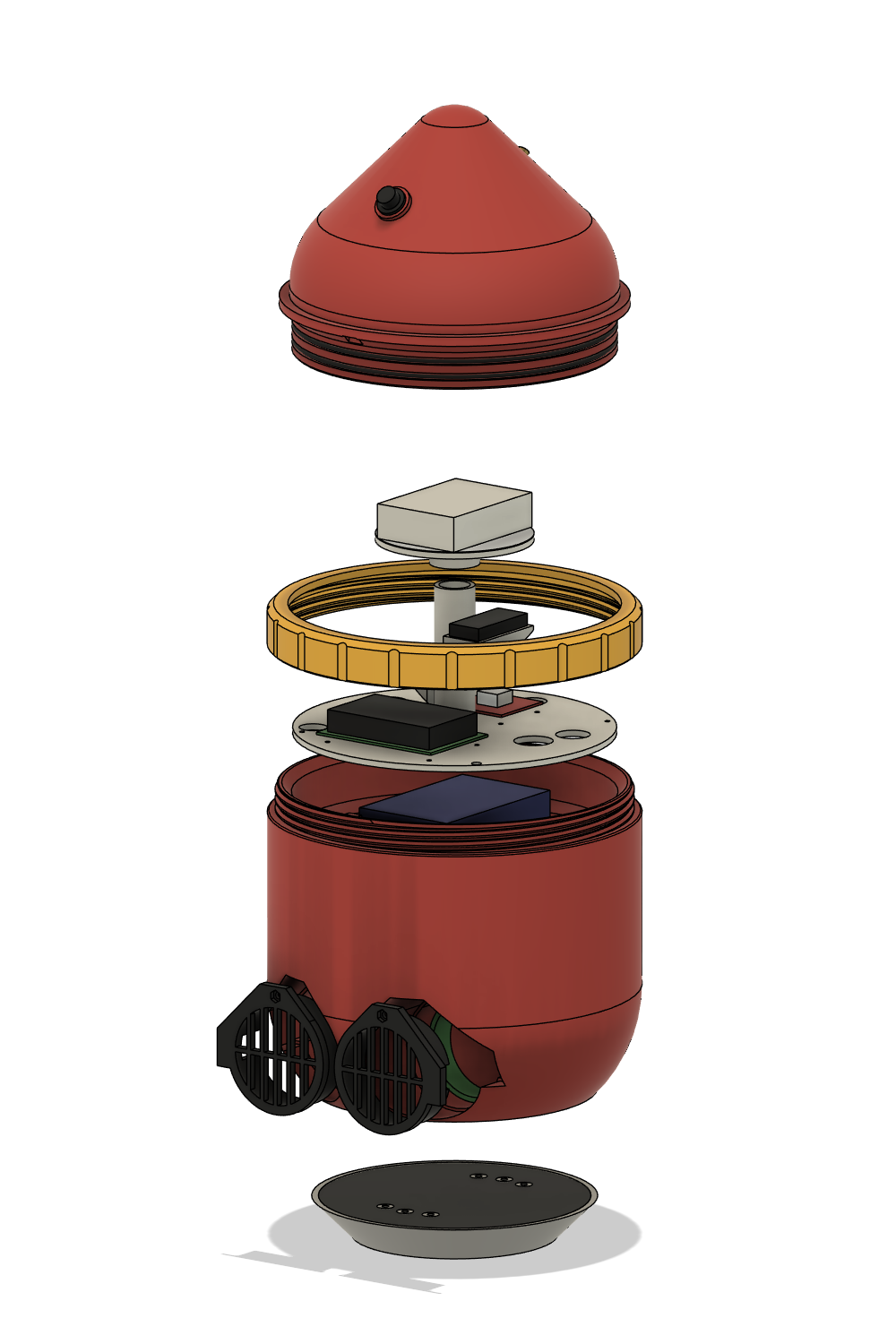
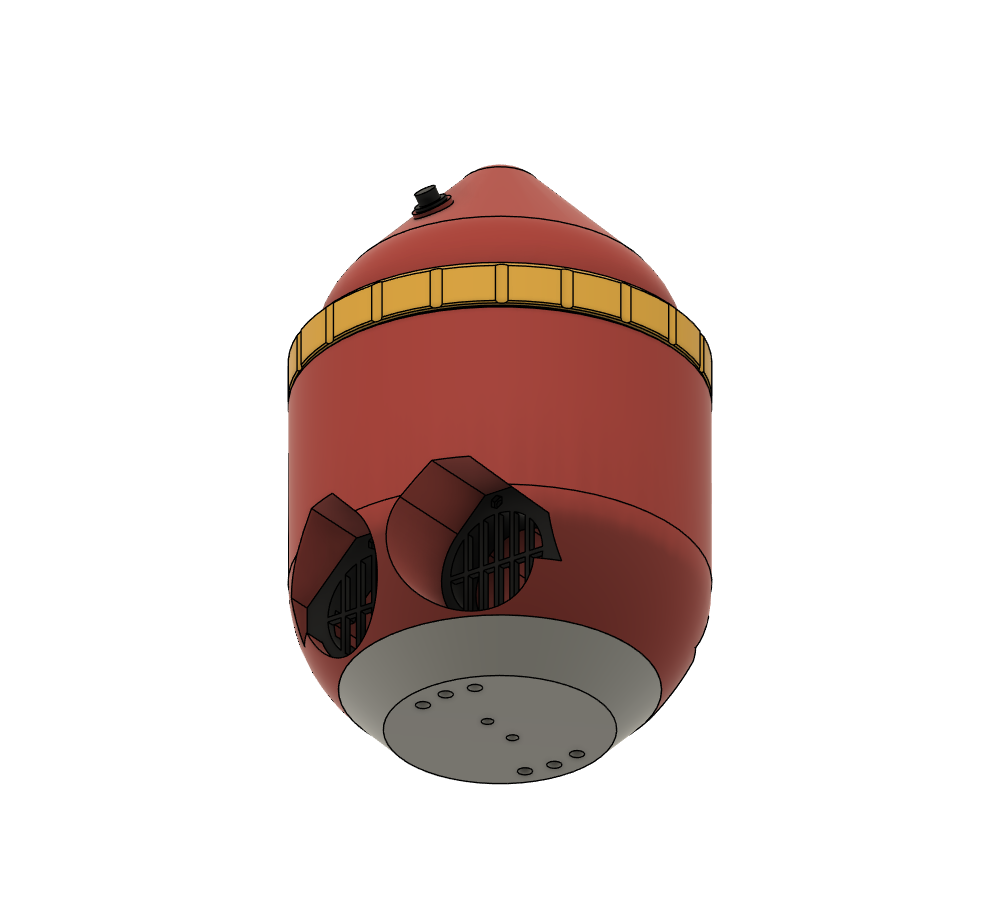
Getting in takes no tools: unscrew the ring, lift the dome, lift the deck out with the electronics on their service loops, and the battery, motor controllers and glands are in plain view. To swap a thruster, undo one nut, pull a grille plug, slide the pod out and free its leads at the gland.
Printing it
Every part prints in PLA on a 250 mm printer at 0.2 mm layers, with six walls so the hull's 2.6 mm skin prints solid, a 10 mm brim outside each part and inside its holes to hold it down, a random seam, and supports off. Each part was sliced and checked layer by layer: every layer stands on the one below, and the only overhangs left are short bridges — the longest the 20 mm flat in each tunnel roof — and ledges of 2.3 mm or less.
| Part | On the bed | Time | PLA |
|---|---|---|---|
| Hull | Flat bottom | 26.5 h | 970 g |
| Dome | Spigot rim | 9.3 h | 354 g |
| Deck | Plate | 4.3 h | 143 g |
| Ring | Lip, upside down | 4.0 h | 138 g |
| Ballast dish | Flat bottom | 3.4 h | 117 g |
| Grille plug × 4 (two of each hand) | Outer face | 0.9 h each | 35 g each |
| Antenna platform | Disc, upside down | 0.8 h | 29 g |
Four features were redesigned to print. The first version had a flat roof on each tunnel's keyway that overhung 12–14 mm, a key hanging under the dome, pads inside the dome that started in mid-air, and shelf gussets wider than the mast they grew from. The keyway roofs now rise at 45°, the key stands on the hull instead, the pads became bosses outside, and the shelves sit on corbels that spread from the mast at 45°.
Building one
Printing comes first: about 52 hours, 26½ of them for the hull. After that, as with the spar, the days are set by cure times rather than effort — five of them from the first coat of epoxy to first water, because the lead is cast only after the float test.
- Measure the pod's lugThe keyway is sized from a guess; check it before the hull is printed.
- Print the partsTen parts, supports off, the hull on a fresh spool.
- Clean up, tap and fit insertsSand the sealing bore, tap the gland columns, press in nine inserts.
- Seal the hullTwo thin coats of epoxy outside and in the tunnels, never on the bore or the thread.
- Dome fittings and O-ringsThe charge/ON socket and the test valve on their bosses.
- Dry-fit the jointThe key in its notch, the ring on by hand.
- Pressure testThe empty shell, pumped up and held under water, before anything goes inside.
- Glands and podsLeads up through sealed glands; each pod clamped between its grille plugs.
- Battery and motor controllersOne fused pack on its bulkheads, the controllers beside it.
- Deck and electronicsBoards, compass, Feather and antenna on the deck, then the deck screwed down.
- Close up and pressure test againFirst power-up, then the joint, glands and fittings tested together.
- Bench testThe thrusters reverse and come to a true stop; charging works with the buoy off.
- Compass and float trimCalibrate, then loose lead in bags until the waterline is right.
- Thrust, current and the one-battery ceilingMeasured in a tub; the thrust limit set to suit one pack, and the compass checked with the motors running.
- Cast the ballast, first waterThe lead set in epoxy in the dish, and the buoy rolled over by hand to prove it rights itself.
Where it can bite
The open questions, and what is done about each:
| Risk | What is done about it |
|---|---|
| The compass is close to the motors | About 170 mm from the motor magnets (the spar manages 380), and 50–60 mm from the battery and the antenna's magnetic base. Calibration takes out fixed fields, not a spinning rotor's or the motor current's. So the first test is heading with the motors stopped and then running; if it shifts by more than about 2°, the shelf moves or the antenna mount changes, and failing that the ball needs another heading source |
| One battery | One pack is rated 12 A, so the thrust ceiling written for two packs must come down: measure current against throttle and keep both pods together under about 10 A. Endurance halves to about 2.3 h |
| The pod's lug is not in its datasheet | The keyway is sized from a guess. Measure a pod and adjust the model before printing the hull |
| Thrust inside a tunnel | The grilles block about a third of each mouth, and a duct in a tunnel loses something too. Measure it with a luggage scale before tuning the controller |
| It rides the wakes | Expected of a ball: it heaves and rolls with each wave, so the antenna moves a few centimetres. The station-keeping logs will show whether it chases them |
| The radio sits low | About 50 mm above the water, so range near the surface is shorter. Range-test two buoys early |
| A flooded hull sinks | Epoxy outside, a pressure test after every reassembly, desiccant inside, and a retrieval line with a float on the rope eye until the buoy has earned trust |
| Heat | The shell is PLA, which softens from about 55 °C. The lake keeps it cool in the water, but a closed car, a hot dock or full sun out of the water gets there, and a softened bore stops sealing. Keep it shaded, never in a car; if that can't be managed, print the hull, dome and ring in PETG (70–80 °C) from the same slicer projects |
| The seal under constant load | The O-rings press on the dome and the hull all the time, and PLA slowly gives under constant load. Store it with the dome off between outings, and pressure-test after the first outings and each season |
| Knocks | PLA cracks where PETG would dent. Inspect the shell after any strike; the soft cover protects it too |
Parts
Beyond the printed parts and the electronics it shares with the spar, the Egg needs O-rings, cable glands, heat-set inserts, stainless fasteners and tie rods, a test valve, an aluminium disc, lead shot and epoxy. The itemised list and the print files are kept with the project but are not published here. The build guide walks through printing and assembly.